
case 01
Summary
In 1999, an independent audit of the Municipality of the Capital City of Budapest was launched to examine allegations of corruption. What began as a fact-finding mission became a battle against political pressure and institutional retaliation.
01
What was uncovered
The audit revealed hidden networks, opaque decision-making and abuse of public resources.
02
What public interest it had
The level of corruption in Budapest is the highest among Hungary’s local governments. A comprehensive package of proposals has been drafted to corruption.
03
What consequences followed
Withdrawal of the completed report, and discrediting of those involved in the due diligence process.
04
What sources it is based on
Attached newspaper articles, disposal report, TIMTE general assembly minutes of 3 June 1999 and the following investigative book:.
Investigation timeline
The Budapest audit
How an independent anti-corruption investigation became a whistleblower case.
In the spring of 1998, the leadership of the Municipality of Budapest sought an independent review of its internal governance and corruption risks. Public debate concerning the management of municipal assets had intensified, and Lord Mayor Gabor Demszky turned to the international anti-corruption community in an effort to establish credibility and public trust.
The assignment was first offered to the Berlin headquarters of Transparency International, led by its founder, Peter Eigen. Although the international organisation did not undertake the work directly, the mandate was eventually accepted by the Transparency International Hungary Association (TIMTE).
To lead the investigation, TIMTE appointed Dr. Istvan Pinter, a former investigating prosecutor and the association’s elected Vice-Chair for Professional Affairs.
What began as a professional audit of municipal governance would ultimately become a dispute over the publication of its findings and, according to Pintér, an example of the personal and professional consequences that can follow independent anti-corruption work.

PART I – the audit
timeline
- OCTOBER 1998
Mayor Gábor Demszky seeks an independent audit of the Municipality of Budapest.
- EARLY 1999
Transparency International Hungary Association (TIMTE) accepts the mandate.
- MARCH 1999
Dr. István G. Pintér is appointed head of the audit committee.
- APRIL 1999
Cooperation agreement secured: the audit team will be independent and the report published independently.
- MAY-DEC 1999
Audit work conducted, documents reviewed, interviews held, systemic risks uncovered.
- 2000-2004
Findings and recommendations face resistance and are not implemented.
- 2005
Transparency International Hungary Association (TIMTE) is dissolved, all its files disapppeared.
- 2005
The Budapest Municipal Government has disposed of all documents, including the TI report.
- 2007
The unresolved issues continue with long-term consequences.
An Unusual Assignment
Dr. Pintér accepted the commission under two conditions.
First, the audit committee had to operate independently from both the Municipality and Transparency International itself. The investigators would select their own experts and determine their own professional conclusions.
Second, the completed report had to be published independently, without political or organisational modification.
The project was financed jointly by the Hungarian Soros Foundation and an entity of the Open Society Institute (OSI), operating from the Central European University. Every six months, detailed professional and financial reports were submitted to the Constitutional and Legal Policy Institute (COLPI), part of the OSI network.
The Lord Mayor appointed Dr. Zsolt Tiba, Chief Municipal Clerk, as the official liaison for the project. Before access to municipal records was granted, all members of the audit committee were required to sign strict confidentiality agreements.
A shadow decision-making system was uncovered – one that bypassed formal processes, concentrated power in a few hands, and created fertile ground for corruption.
Audit Committee Report (1999)
Inside the Municipality
For the next eight months, the audit committee examined the internal operation of the Municipality of Budapest.
Independent legal, financial, and administrative experts reviewed contracts, regulations, procurement procedures, and decision-making mechanisms. Municipal officials and civil servants were interviewed, while large volumes of internal documentation were made available to the investigators.
The committee was not established to investigate individual criminal offences. Its objective was to identify the institutional conditions that could create opportunities for corruption or weaken accountability.
As the work progressed, the investigators found that the questions they were asking increasingly extended beyond administrative procedures and into the structure of governance itself.
What the audit found
According to the final report, the Municipality formally operated through its legally established institutions, committees, and administrative bodies.
At the same time, the audit committee concluded that many important decisions were prepared and coordinated outside these official structures.
The report described the existence of what it called a “shadow decision-making system,” in which a relatively small circle of SZDSZ Free Democrats and MSZP Hungarian Socialist Party politicians, lawyers, and external advisers worked together with the Lord Mayor in preparing major municipal decisions.
As more documents were examined and more officials were interviewed, the audit gradually shifted its focus from isolated corruption risks toward the broader institutional mechanisms that made such risks possible.
The investigators also encountered important limitations. They were unable to audit certain areas, including the financial settlement of the Lord Mayor’s foreign trips and significant parts of the management of municipally owned companies, which formed the backbone of Budapest’s asset management system.
The audit team also became aware that hundreds of cassette recordings documenting verbal decisions existed within the Mayor’s Office. Permission to review these recordings was never granted.
The final report
The completed audit was not merely a description of institutional weaknesses.
It also contained a comprehensive package of recommendations intended to strengthen transparency, improve accountability, and reduce opportunities for corruption within the Municipality.
The report proposed stronger independent oversight, clearer separation between political and administrative decision-making, more transparent procurement procedures, and improved governance of municipally owned companies.
In accordance with the project’s rules, the completed report was first presented to the leadership of TIMTE and to Chief Municipal Clerk Dr. Zsolt Tiba before publication.
According to Dr. Pintér, neither party raised substantive professional objections at that stage. The report was then presented publicly at a joint press conference.
For the audit committee, the assignment had been completed.
PART II – the conflict
When the conflict began
Shortly after the report entered the public domain, the situation changed.
Criticism began to emerge, not primarily concerning individual findings, but regarding the report as a whole.
The Chief Municipal Clerk submitted a number of requested corrections. Dr. Pintér indicated that he was prepared to review each point, but doing so would require renewed access to the original materials that had already been returned to the Municipality.
According to the audit committee, the majority of the requested corrections could have been resolved through a brief factual review and would not have altered the substance of the report.
Instead, the leadership of TIMTE demanded that the entire document be fundamentally rewritten.
The dispute moves beyond the report
The centre of the conflict gradually shifted away from the audit itself.
The dispute came to involve two leading figures within the association: Péter Vadász, Chairman of TIMTE, and later Ádám Terták, head of Ernst & Young Hungary and subsequently Dean of the CEU Business School. TI Berlin sent Miklos Marschall, Demszky’s former deputy, to Hungary to handle the matter.
According to Dr. Pintér, the request to rewrite the report was never accompanied by clearly identified professional objections. At the same time, questions began to be raised concerning the project’s financial administration.
This development came as a surprise to the audit committee. The Soros Foundation and the Constitutional and Legal Policy Institute had already accepted the completed work and its financial settlement in writing.
Meeting records from the period show that the project’s experts had been selected openly and that the interim reports had been approved by the association’s leadership.
Nevertheless, the focus increasingly moved away from the findings of the investigation and toward the conduct of the investigation itself.
The report that had already been publicly presented gradually came to be described within the organisation as “unfinished.”
A second investigation
While the dispute over the Budapest audit continued, Dr. Pintér began coordinating an even broader project.
Building on the lessons of the municipal investigation, the new study examined the Hungarian legal system as a whole from the perspective of corruption prevention.
The report analysed institutional safeguards across the legal framework and proposed a series of reforms designed to strengthen integrity and accountability at the national level.
Drafts of the study were circulated to several public institutions, including the State Audit Office and the Office of the Prosecutor General.
Unlike the Budapest audit, however, this second report was never officially published.
According to Dr. Pintér, the disappearance of this study represented the loss of a comprehensive anti-corruption reform programme for Hungary.
PART III – the consequences
The investigator becomes the issue
By this stage, the central question was no longer simply the content of the Budapest audit.
For Dr. Pintér, the focus had shifted from the findings to the investigator himself.
The internal disagreement evolved into a wider conflict over the legitimacy of the report and the professional credibility of its author.
According to the documents collected by Dr. Pintér, critical assessments of the project were communicated not only within the association but also to Transparency International’s international leadership, to the funding organisations, and to other external institutions.
In Dr. Pinter’s interpretation, the Budapest audit became the starting point of a prolonged reputational campaign that extended beyond Hungary.
The original purpose of the investigation—to identify corruption risks and recommend institutional reforms—had been overshadowed by the controversy surrounding the report itself.
The end of TIMTE
The Transparency International Hungary Association continued to operate for several years after the Budapest audit.
During this period, it remained financially supported by organisations within the Open Society network and continued to produce professional studies.
At the same time, internal tensions concerning the future direction of the organisation grew.
According to Dr. Pintér’s account, increasing pressure was placed on the association to engage more directly in political activities, while uncertainty also emerged regarding the continued use of the Transparency International name.
On 1 March 2005, the general assembly resolved to dissolve the association. The formal legal process concluded the following month when the organisation was removed from the court register.
On 20 April 2005, court clerk dr. Szilvia Homolya complied with the request by issuing order number 9.Pk. 61.332/1996/14.
For Dr. Pintér, the dissolution marked the end of an independent Hungarian anti-corruption initiative that had originally sought to address systemic governance problems through professional analysis rather than political advocacy.
Why this story matters
The Budapest audit began as an independent review of corruption risks within the Municipality of Budapest.
It evolved into a dispute over the publication and ownership of a completed investigation, and ultimately into a broader question concerning the position of independent investigators when their findings become politically sensitive.
Whether viewed as an institutional conflict or as a whistleblower case, the events surrounding the Budapest audit raise enduring questions about transparency, accountability, and the protection of those who expose systemic weaknesses in public institutions.
The complete chronology, supporting documentation, and source materials are available in the accompanying report.
MOST AKKOR KIRAKJUK IDE AZ EREDETI, TELJES CIKKET IS, VAGY HOGY LEGYEN?
Supporting documents
Newspaper Nepszabadsag 03.09.1998.
Petition for the Deregistration of Transparency International Hungary
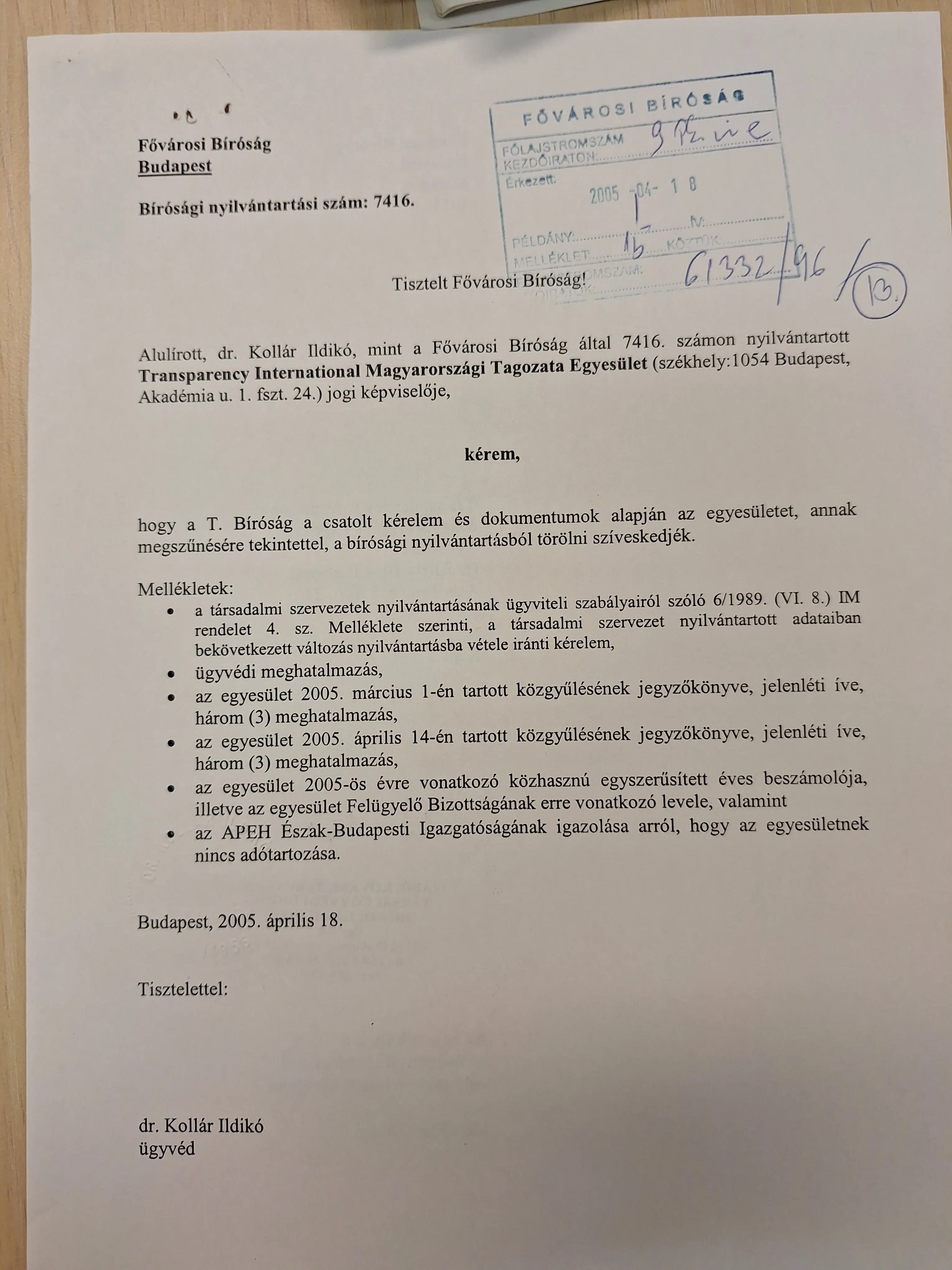
Court Order on the Deregistration of Transparency International
Pintér, I. (2025). A külföldi korrupció hatása a magyar szuverenitásra. (Műhelymunkák, 2025/1., p. 410). ISSN 1788-7895; ISBN 978-963-9816-39-8. Budapest: Geopolitikai Tanács Közhasznú Alapítvány, 2025. https://cgeopol.hu/muhelymunkak/
Attached issued order by Budapest Court (number 9.Pk. 61.332/1996/14.) on 20 April 2005.